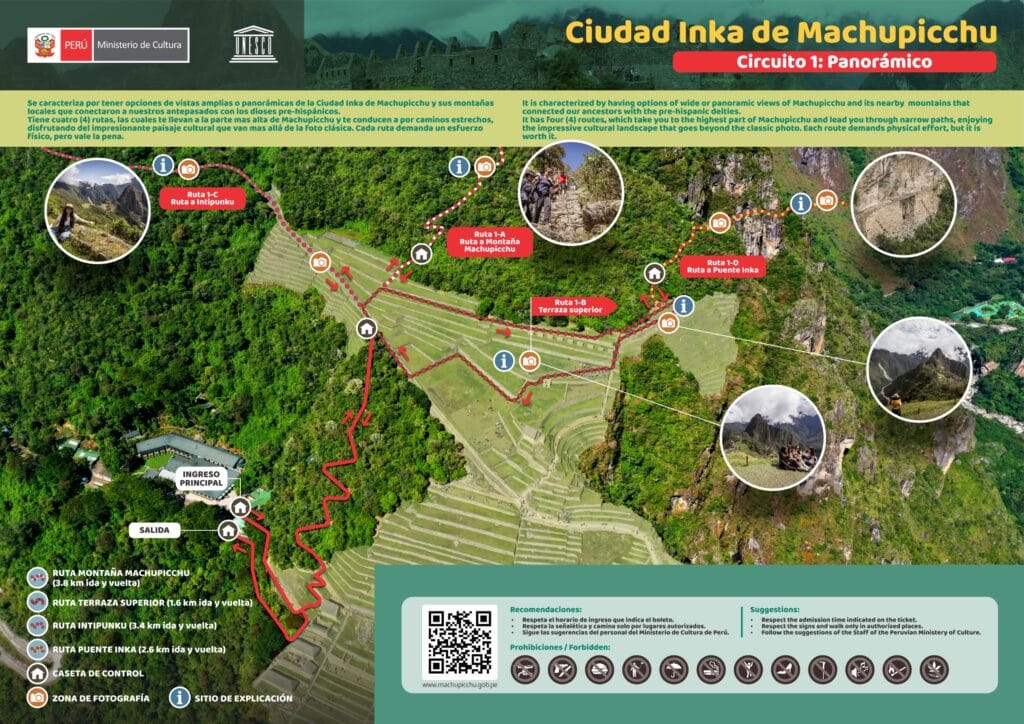
Visiting Machu Picchu is a once-in-a-lifetime experience, and doing it the right way makes all the difference. To protect this World Heritage Site and improve visitor flow, access is organized through official Machu Picchu circuits, each designed to offer a specific route. Choosing the right circuit will help you enjoy the visit more and make the most of your time in Cusco.
If you want a stress-free experience, booking a Machu Picchu organized tour is the best way to explore this wonder comfortably and safely.
See informations from ministerio de cultura
The Machu Picchu circuits are clearly marked routes that guide visitors through the citadel in a specific order. Each circuit includes different archaeological sectors and has a set duration. Leaving the assigned route is not allowed, so choosing the right circuit when purchasing your ticket is essential.
By reserving a Machu Picchu tour package from Cusco, you secure access to the most suitable circuit for your travel style, along with transportation, a professional guide, and personalized assistance.
Circuit 1 runs through the upper part of Machu Picchu and is ideal for travelers looking for breathtaking panoramic views and the classic postcard photos of the citadel. It is a short, low-difficulty route, perfect for those with limited time.
This circuit is often included in panoramic Machu Picchu tours, ideal for visitors who want a visually stunning but relaxed experience.
Circuit 2 is the most recommended option, especially for first-time visitors. It combines panoramic viewpoints with access to Machu Picchu’s most important archaeological areas, such as the Sacred Plaza, the Temple of the Sun, and the Sacred Rock.
This route is part of many complete Machu Picchu tour packages, as it offers a deeper understanding of Inca history, architecture, and spiritual significance. If you are looking for a well-rounded and enriching experience, this is the best circuit to choose.
Circuit 3 focuses on the lower section of Machu Picchu and is often combined with trekking routes such as Huayna Picchu or Machu Picchu Mountain. It is designed for adventurous travelers with good physical condition.
Many adventure Machu Picchu packages include this circuit, combining history, nature, and challenging hikes.
When selecting the best Machu Picchu circuit, consider your available time, physical condition, and travel interests. Booking an all-inclusive Machu Picchu tour allows you to choose the right circuit without worrying about logistics.
Choosing a reliable tour operator is key to an unforgettable journey. With Sunrise Experience Cusco, you can book customized Machu Picchu tour packages, guided by professionals who offer personalized service and local expertise.
Book your Machu Picchu experience from Cusco today and discover this ancient wonder the best way possible.
Cusco’s gastronomy isn’t only enjoyed in traditional restaurants or gourmet proposals. When evening falls and the city comes alive, another world of flavors appears: street food carts, fast, tasty, and deeply local.
Food carts are part of everyday life in Cusco. They are meeting points, late-night cravings, and an authentic way to discover the city one bite at a time.
🌙 Why try street food in Cusco?
Because it is:
Here, you don’t just eat—you observe, chat, and share with locals.
🔥 Street food snacks you can’t miss
A must-try classic. Beef heart skewers marinated in ají panca and spices, grilled over charcoal and served with potatoes and chili sauce. Bold, juicy, and full of flavor.
Filled with meat, cheese, or chicken. Perfect to eat on the go and satisfy your hunger quickly.
A traditional Andean snack: giant white corn served with fresh cheese. Simple, hearty, and very Cusco-style.
Prepared fresh, with warm bread and generous fillings. Ideal for a casual and budget-friendly dinner.
📍 Where to find the best food carts
Street food carts are mainly found:
Follow the local rule: where there’s a line, there’s good food 😉
💡 Tips for enjoying street food
✨ Eating on the go is also traveling
Street food in Cusco is straightforward, honest, and unpretentious. It doesn’t try to impress—it aims to satisfy and accompany. It’s part of daily life, the walk home, nighttime conversations, and shared cravings.
📌 If you want to know the real Cusco, try its food carts.
Because here, some of the best stories are told standing up—with something delicious in your hand 🌮🔥
If you’d like, I can adapt this for video, make it more commercial, or turn it into a quick street food guide for Cusco.
Visiting Machu Picchu is the dream of thousands of travelers… but one of the most common mistakes is leaving the reservation until the last minute. Every year, many people arrive in Cusco thinking they can easily buy their entrance ticket—only to face an unpleasant surprise: sold-out tickets.
If you want to avoid stress, changes to your plans, and unnecessary expenses, here’s why booking Machu Picchu in advance is essential and how to do it the right way.
🚫 Limited (and strictly controlled) daily entries
Daily access to Machu Picchu is strictly limited to protect the archaeological site. This means:
👉 Simply arriving in Cusco does not guarantee entry to Machu Picchu.
🗓️ Schedules and circuits: not all visits are the same
Machu Picchu is currently visited through specific circuits and time slots. Booking in advance allows you to:
If you wait until the last minute, only limited options—or none at all—may be available.
🚆 Trains and transportation also fill up
It’s not just the entrance ticket. Transportation to Machu Picchu Pueblo (Aguas Calientes) is also in high demand:
Booking ahead gives you better schedules and more stable prices.
🥾 Inca Trail: even more advance planning required
If you dream of hiking the Inca Trail, planning ahead is absolutely essential. Permits are very limited and usually sell out 4 to 6 months in advance.
👉 There’s no room for improvisation here.
💸 Is booking in advance more expensive?
Actually, no. Booking early often helps you:
Last-minute travel almost always costs more.
💡 Key tips for booking Machu Picchu
✨ Travel relaxed, enjoy more
Machu Picchu is not a destination to leave to chance. Booking in advance allows you to travel stress-free, avoid forced changes, and feel confident knowing you’ll experience one of the most important journeys of your life.
📌 Avoid unnecessary surprises:
Plan ahead, book on time, and let Machu Picchu amaze you… for all the right reasons 🏔️✨
Traveling to Cusco for the first time is exciting… but it can also be a bit challenging. The altitude, the number of places to see, and the cultural intensity make the first few days especially important to fully enjoy your trip.
If this is your first time in Cusco, this guide will help you know what to do when you arrive, which activities to prioritize, and which tips to follow so your experience is truly unforgettable.
Cusco is located at over 3,300 meters (10,800 ft) above sea level, so the first priority is to acclimate to the altitude.
👉 Don’t try demanding tours on your first day. Your body will thank you.
Once you’re settled in, take a walk through the heart of the city. The historic center is perfect for a gentle first introduction to Cusco.
It’s best to explore this area without rushing and at your own pace.
Cusco is surrounded by impressive Inca ruins that don’t require long trips.
These sites are ideal for your second day, once you’re a bit more acclimated.
After one or two days in Cusco, the Sacred Valley is the perfect place to continue your adventure. It sits at a lower altitude and offers breathtaking landscapes.
It’s also an excellent way to continue acclimatizing before visiting Machu Picchu.
The highlight of the trip requires advance planning. Entrance tickets, trains, and schedules sell out quickly.
👉 Key tip: buy your tickets weeks or even months in advance, especially during high season.
Traveling to Cusco for the first time isn’t about rushing from one place to another—it’s about experiencing it calmly: adapting, observing, tasting new flavors, and connecting with history.
📌 Cusco isn’t just visited—it’s felt.
If you organize your days well and follow these tips, your first trip will be just the beginning of a lifelong connection with this magical city
If you’re planning a trip to Cusco, there’s a key question many travelers ask (sometimes too late):
👉 Should you bring soles or dollars? Where can you exchange money without losing too much?
Exchanging money in Cusco is easy, but doing it the wrong way can cost you more than necessary. Here’s everything you need to know before exchanging your money, so you can travel with peace of mind and protect your budget.
💰 What currency is used in Cusco?
Peru’s official currency is the Peruvian sol (PEN), and it’s what you’ll need for most everyday expenses:
👉 Quick conclusion: in Cusco, soles are essential.
💵 Are US dollars accepted in Cusco?
Yes, but only in certain places, such as:
⚠️ Important: when you pay in dollars, the exchange rate is usually not in your favor. That’s why it’s best to use dollars only as a backup.
🏦 Where to exchange money in Cusco?
These are the most common options, from best to worst:
📍 Tip: compare rates at 2 or 3 places before exchanging.
💳 Cash or card?
The best option is to use both:
🔔 Important: in markets and nearby towns, cards are not always accepted.
💡 Key tips to avoid losing money
🌄 How much money should you bring?
It depends on your travel style, but as a daily reference:
(Not including major tours like Machu Picchu)
✨ Travel informed, travel relaxed
Knowing what currency to bring and where to exchange it will make your trip to Cusco much smoother. A small detail can make the difference between fully enjoying your experience or paying more than necessary.
📌 Final tip: bring dollars as a backup, exchange to soles little by little, and enjoy Cusco without worries
Traveling to Cusco is an unforgettable experience at any time of the year. However, each season offers different landscapes, activities, and sensations. Knowing when to go will help you choose the experience that best matches your travel style—adventure, culture, festivities, or relaxation.
Here’s a month-by-month guide to Cusco so you can plan your ideal trip.
☀️ Dry season (May to September): the travelers’ favorite
This is the best time to travel to Cusco if you’re looking for good weather and clear skies. Days are sunny and nights are cold—perfect for hiking and outdoor excursions.
✅ Experiences to enjoy
🔔 Traveler tip: This is high season, so book flights, hotels, and tickets well in advance.
🌸 Shoulder season (April and October): the perfect balance
Ideal for travelers looking for fewer crowds and more affordable prices without sacrificing good weather. Landscapes are lush and green, and the atmosphere is more relaxed.
✅ Experiences to enjoy
✨ A great option for cultural trips and leisure travel.
🌧️ Rainy season (November to March): a greener, more authentic Cusco
Although rainfall is more frequent—especially in January and February—this season shows a more natural and less touristy side of Cusco. It also coincides with lively traditional festivities.
✅ Experiences to enjoy
⚠️ Important note: February often brings restrictions on some trekking routes, such as the Inca Trail.
🎭 Festivities that shape the travel season
Cusco is a city that celebrates all year round. Key dates include:
Traveling during a festival means immersing yourself in Cusco’s living culture.
💡 Final tips for choosing when to travel
✨ Cusco, a year-round destination
There isn’t just one best time to travel to Cusco—there’s the best time for you. Each season offers unique experiences, from hikes under blue skies to colorful festivals full of tradition.
📌 Cusco always has something to show you, no matter when you decide to visit.
In Cusco, Carnival doesn’t start all at once—it is announced with laughter, jokes, and plenty of playful mischief. This perfect prelude has a name of its own: Compadres and Comadres, one of the most fun, irreverent, and beloved traditions in Cusco’s festive calendar.
More than just a celebration, Compadres and Comadres is a social game filled with humor, satire, and togetherness, where no one escapes a good-natured joke.
🎭 What are Compadres and Comadres?
It is a festivity celebrated on two consecutive Thursdays before Carnival Sunday:
Each day is symbolically dedicated to men and women, respectively, and is marked by public jokes, satirical figures, and celebrations among friends, families, and entire neighborhoods.
😂 The tradition of the dolls
One of the most eye-catching elements is the creation of life-sized dolls, made from old clothes, straw, and masks. These dolls humorously and exaggeratedly represent compadres or comadres—friends, neighbors, public figures, or even social stereotypes.
The dolls are hung from balconies, poles, or placed in public squares, accompanied by playful, witty messages. The goal is not to offend, but to spark laughter and a sense of shared fun.
📍 Where is the celebration held?
Although the festivities take place throughout the city, traditional neighborhoods and Cusco’s Plaza de Armas gather much of the festive atmosphere. Celebrations are also common in family courtyards, markets, and main streets.
🎶 Music, toasts, and good humor
During Compadres and Comadres, you’ll always find:
It’s a celebration where locals and visitors easily blend together. If you’re in Cusco on these days, be ready to join the fun 😄.
💡 Tips to enjoy Compadres and Comadres
🌄 The perfect start to Carnival in Cusco
Compadres and Comadres officially mark the beginning of Cusco’s Carnival. It’s the perfect warm-up before the big days of yunza celebrations, water games, and large street festivities.
✨ If there is one day that truly reflects Cusco’s joyful, creative, and communal spirit, it is this one. Laughing at yourself, sharing moments, and celebrating together is the essence of a tradition that remains alive year after year.
Traveling to Cusco during this time means discovering that here, Carnival is not only danced—it’s also joked about, shared, and celebrated as a community 🎊🎭
Carnivals in Cusco are not only celebrated with music, dances, and water games—they are also experienced through their traditional gastronomy, an explosion of flavors that brings together history, community, and celebration. During the months of February and March, Cusco’s tables are filled with hearty dishes, perfect for sharing and enjoying together.
Carnival food is synonymous with abundance, family gatherings, and Andean cultural heritage. Here, we tell you which flavors you absolutely must try if you visit Cusco during this festive season.
The Cusco puchero, also known as timpu, is the most representative dish of Carnival. It is a generous soup made with different meats (beef, lamb, chicken), potatoes, yucca, cabbage, carrots, chickpeas, and peach, served with rice and chili pepper.
🍽️ Why is it eaten during Carnival?
Because it symbolizes abundance, family unity, and collective celebration. It is traditionally served on Carnival Sundays or Mondays and shared among neighbors and relatives.
Although it is better known from the Corpus Christi celebrations, chiriuchu also appears on some tables during Carnival, especially in more traditional areas. This cold dish combines guinea pig, chicken, sausage, cheese, corn tortilla, seaweed, and rocoto pepper.
It is a perfect example of Andean culinary fusion and a unique gastronomic experience for visitors.
During Carnival, the streets are filled with stalls offering artisan sweets such as:
To accompany them, you’ll also find traditional drinks, such as chicha de jora or homemade refreshments made from Andean fruits.
In Cusco, Carnival food is not just nourishment—it is part of the festive ritual. Cooking in large quantities, sharing meals, and sitting together strengthen social bonds and keep alive a tradition passed down from generation to generation.
Many local restaurants and traditional markets adapt their menus during this season, offering special dishes that are perfect for travelers seeking authentic experiences.
Carnivals in Cusco are danced, sung… and eaten. Tasting the local gastronomy is one of the best ways to connect with the culture and experience the celebration from the inside.
If you visit Cusco during Carnival season, don’t leave without trying these traditional flavors. Because here, celebrating also means sharing a good meal. 🍲🎭
Carnivals in Cusco are one of the most anticipated festivities of the year. Between February and March, the former capital of the Tahuantinsuyo fills with music, dances, water games, and a collective energy that spreads to locals and travelers alike. It’s not just a celebration—it’s a living expression of Andean cultural identity.
📍 Where are the carnivals celebrated?
Mainly in the city of Cusco and in nearby communities such as Urubamba, Calca, and Pisac. The heart of the celebration is usually centered around Cusco’s Main Square (Plaza de Armas), although traditional neighborhoods host their own festivities.
🗓️ When do they take place?
Dates vary each year because they depend on the religious calendar, but they generally occur between February and March, culminating on what is known as Carnival Sunday.
🎶 Most representative traditions
🌳 La Yunza or Cortamonte
This is the central activity of Cusco’s carnival. A tree is decorated with gifts, balloons, and streamers. Couples dance around it while taking turns cutting the trunk; whoever brings it down becomes the sponsor for the following year.
💃 Dances and popular music
Parades fill the streets with huaynos, traditional carnival songs, and playful, humorous chants. The music never stops—and anyone can join the dancing.
💦 Water and talcum powder games
One of the most fun (and chaotic 😄) customs. Friends and strangers throw water, foam, and talcum powder at each other as a symbol of purification and joy. Traveler tip: protect your camera and phone.
🍲 Typical carnival cuisine
During these dates, you’ll often find traditional dishes such as:
💡 Tips to enjoy the carnivals
🌄 Carnivals + tourism in Cusco
Experiencing carnival season is a perfect excuse to combine culture and adventure: archaeological sites, local cuisine, and traditional celebrations all in one trip.
✨ Carnivals in Cusco aren’t just watched—they’re lived. They’re laughter, music, tradition, and community at their most authentic. If you’re looking for a truly cultural experience, this is the perfect time to discover Cusco at its most joyful and colorful.
If you’d like, I can adapt it to a tourism blog style, make it more commercial, or include a travel itinerary + carnival activities. How would you like it? 🎒🎉
Peru is not only home to Machu Picchu and breathtaking landscapes — it is also one of the world’s top culinary destinations. Peruvian cuisine blends ancient Inca ingredients with Spanish, African, Chinese, and Japanese influences, creating flavors you won’t find anywhere else.
If you’re planning a trip to Peru, tasting the local food is an essential part of the experience. Here are 10 traditional Peruvian dishes you simply can’t miss.
🍋 1. Ceviche
Peru’s national dish. Fresh raw fish is marinated in lime juice, mixed with red onions, chili, and cilantro. It’s refreshing, spicy, and full of flavor.
👉 Best enjoyed fresh at lunchtime.
🥩 2. Lomo Saltado
A delicious stir-fry combining beef, onions, tomatoes, soy sauce, and French fries, served with rice. A perfect example of Peru’s Chinese-influenced cuisine.
👉 Comfort food with a Peruvian twist.
🥔 3. Papa a la Huancaína
Boiled potatoes topped with a creamy, mildly spicy yellow chili cheese sauce. Often served as a starter.
👉 Simple, colorful, and full of flavor.
🍲 4. Ají de Gallina
Shredded chicken in a rich, creamy sauce made with yellow chili peppers, cheese, milk, and bread, served with rice and potatoes.
👉 A favorite homemade comfort dish.
🌽 5. Rocoto Relleno
A spicy red pepper stuffed with seasoned meat, vegetables, and cheese, baked to perfection. Originally from Arequipa.
👉 For travelers who love bold flavors.
🐟 6. Tiradito
Similar to ceviche but with a Japanese influence. Thin slices of raw fish served with a spicy citrus sauce.
👉 A beautiful fusion dish.
🍖 7. Anticuchos
Grilled skewers of marinated beef heart (or other meats), traditionally sold as street food. Smoky, tender, and surprisingly delicious.
👉 A must-try street food experience.
🍛 8. Arroz con Pollo
Chicken cooked with cilantro rice, vegetables, and Peruvian spices. A classic family dish found all over the country.
👉 Flavorful and comforting.
🥟 9. Causa Rellena
Layers of mashed yellow potatoes seasoned with lime and chili, filled with tuna, chicken, or seafood.
👉 Served cold and beautifully presented.
🍮 10. Picarones
A sweet Peruvian dessert similar to donuts, made with squash and sweet potato dough, served with syrup.
👉 The perfect treat after a day of exploring.
Food in Peru is more than just a meal — it’s part of the country’s culture and history. From traditional markets to fine dining restaurants, every dish tells a story.
At Sunrise Experience Cusco, we can help you discover authentic Peruvian flavors during your journey, whether through local restaurant recommendations or cultural experiences in Cusco.
📩 Ready to explore Peru through its food? Contact us and make your trip unforgettable.


 Mon-Fri: 9:00 AM - 6:00 PM | Sat: 9:00 AM - 1:00 PM (PET)